
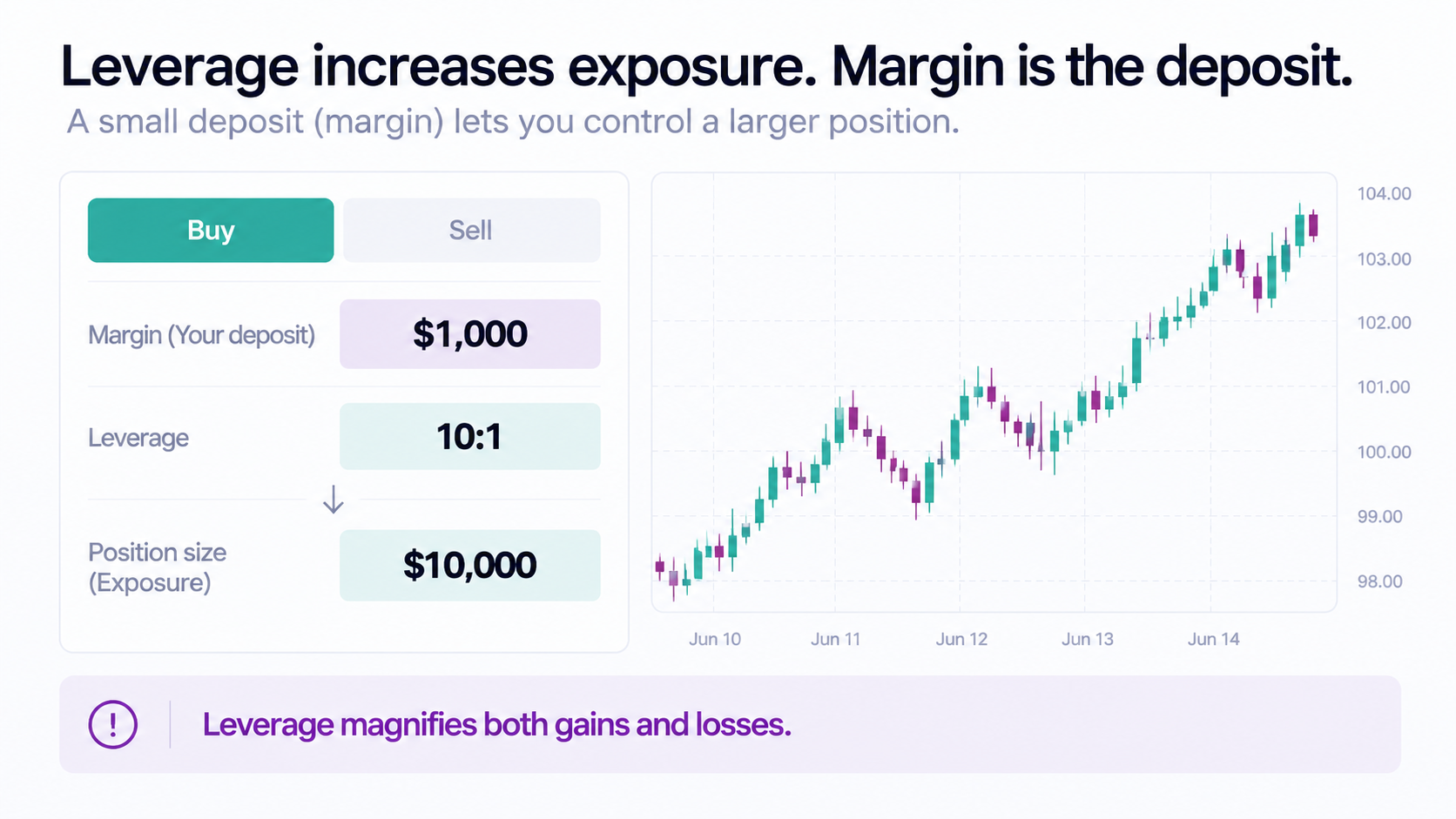
In one lineLeverage increases your market exposure. Margin is the capital required to hold that exposure.
Leverage in simple terms
Example
With 10:1 leverage:
$1,000 can control a $10,000 position.
Leverage does not make the trade safer or better. It simply allows a larger position to be controlled with less capital.
Why leverage can be dangerous
If a $10,000 position moves 1%, the change in value is about $100.
If only $1,000 of margin was supporting that position, that $100 movement equals 10% of the $1,000 margin amount.
This is why small market movements can have a large effect when leverage is high.
What is margin?
Margin is the amount of account equity set aside to support a leveraged position.
Important:Margin is not the same as the maximum amount you can lose. Actual risk depends on position size, price movement, stop placement and execution.
The safer way to think about leverage
Do not ask, “How large a trade will my broker allow?”
Ask, “How much am I prepared to lose if this trade is wrong?” Then calculate the position size from that risk.
Related toolMargin CalculatorEstimate margin →
Remember this
- Leverage increases exposure.
- Margin supports the leveraged position.
- Available leverage should never decide your risk.
Educational content.
This lesson is provided for general educational and informational purposes and is not personal financial or investment advice.