
In one lineRisk management is deciding how much you are prepared to lose before you enter the trade.
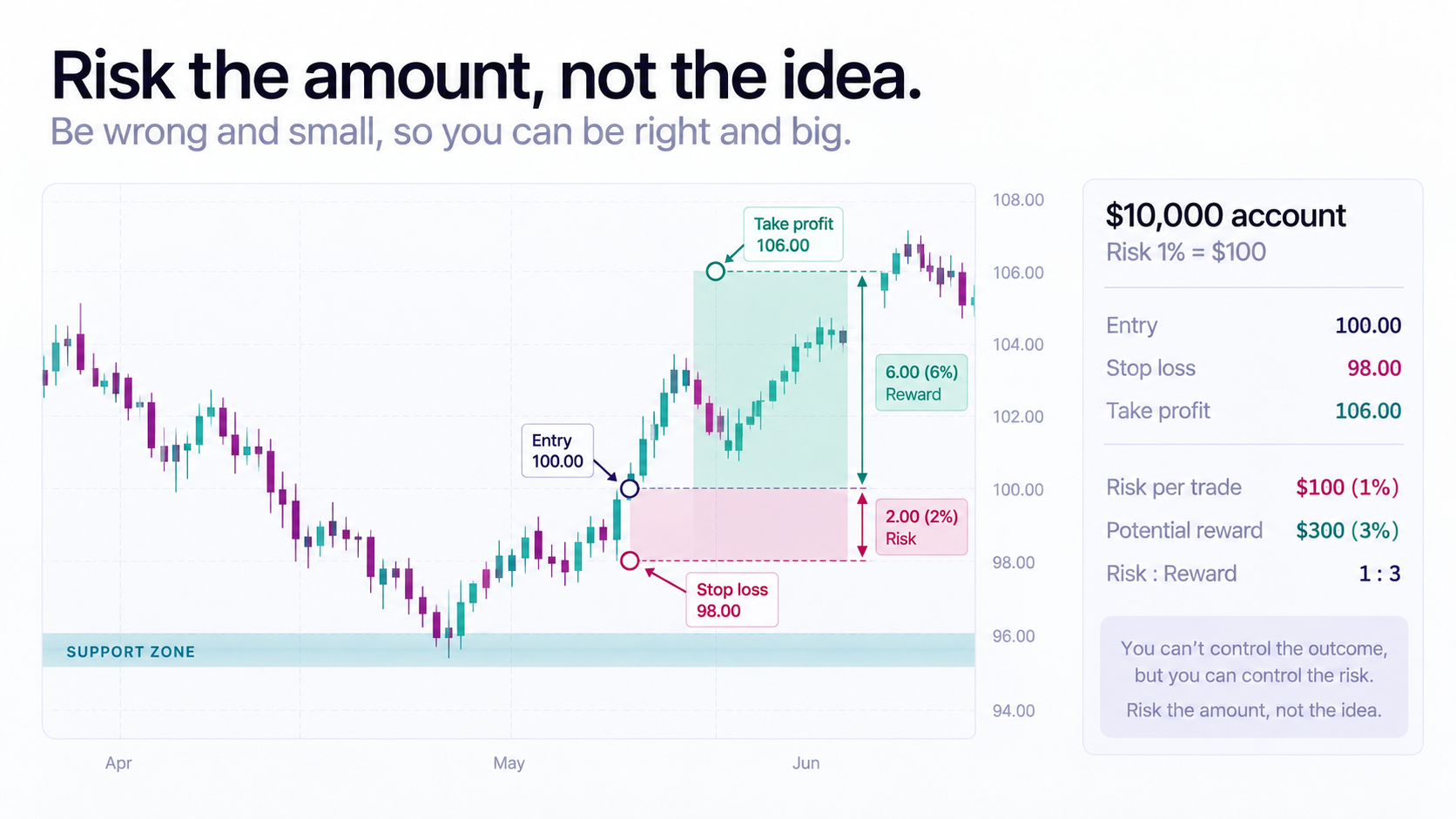
You cannot control the next trade
No setup wins every time. Even a good trading idea can fail.
You cannot control the next candle, but you can control:
- how much money you risk
- your position size
- your total exposure
- whether you take the trade at all
A simple $10,000 account example
Example
Account balance: $10,000
Planned risk: 1%
Maximum planned loss = $100
If the trade is wrong and the stop is reached under normal conditions, the plan is to lose about $100 rather than an unknown amount.
Why small risk matters over many trades
If you risk a fixed $100 and lose five trades in a row, the total loss is $500.
That is uncomfortable, but the account still has room to continue, review the process and learn.
If the same trader risks $1,000 on each trade, the same five losses would be far more damaging.
Risk management does not remove losses
Its job is not to stop losing trades. Its job is to make sure normal losing periods remain manageable.
Related toolPosition Size CalculatorPlan the dollar risk →
Remember this
- Decide risk before entry.
- Keep single-trade risk small enough to survive a losing sequence.
- Protecting capital gives you time to improve.
Educational content.
This lesson is provided for general educational and informational purposes and is not personal financial or investment advice.